What Are the Safest Ways to Hire Local Help?
Last Updated: October 26, 2026
Quick Summary
The safest ways to hire local help start with verifying a worker’s government-issued ID, platform badges, and recent reviews before you book. Pay through in-app escrow or a credit card rather than cash up front, and get the scope, price, and damage terms in writing before work begins.
- Read the last five customer reviews, not the first five, and watch for patterns rather than praise.
- In-app escrow holds your funds until you confirm the job is done, giving the most protection.
- Never pay a large deposit to someone you have not verified first.
- A written agreement should cover scope, exclusions, price, timeline, damage terms, and payment method.
- Confirm the worker’s name and ID match your booking before letting them inside.
Table of Contents
- Start With Verification Before You Hire Local Help
- Questions to Ask Before Hiring a Handyman or Any Local Worker
- Safe Ways to Pay Local Workers Without Getting Burned
- Red Flags When Hiring Movers and Other Household Help
- Get the Scope, Price, and Damage Terms in Writing
- Safety Measures to Follow When Help Arrives at Your Home
- Post Your First Job on Biddy Jobs
- Frequently Asked Questions
Start With Verification Before You Hire Local Help
The safest ways to hire local help always start with one step: confirm who you are letting through the door.

Verification is the process of confirming a worker’s identity, history, and reputation before you invite them into your home. It turns a stranger into a known quantity.
Here is what to check, in order:
- Government-issued ID: Match the name and photo to the person who shows up.
- Platform verification badges: Look for ID-verified accounts, not just “email confirmed.”
- Customer reviews: Read the last five, not the first five.
A common mistake is skipping the ID match because the reviews look great. Reviews can be gamed. An ID check is harder to fake.
ID Checks, Reviews, and Reputation Signals That Matter
Reviews tell you how a worker behaves. An ID check tells you who they are. You need both.
Read reviews for patterns, not praise. One glowing review means little. Five reviews that all mention “on time” and “cleaned up after” mean something.
For a deeper walkthrough of the full process, our guide on how to verify local service workers breaks it down into seven clear steps.
Questions to Ask Before Hiring a Handyman or Any Local Worker
Ask direct questions before you book, and listen for clear answers. A good worker welcomes them. A vague worker dodges them.
Try these:
- “Are you licensed and insured for this type of work?”
- “Can you send a written estimate before we start?”
- “What happens if something gets damaged?”
If the answer to any of these is “don’t worry about it,” worry about it. That is your signal to walk away.
For handyman-specific vetting, including the exact license checks to run, see our guide on how to find reliable handymen.
Safe Ways to Pay Local Workers Without Getting Burned
Cash up front is the riskiest way to pay. You lose all use of the money the moment it leaves your hand, and you have no paper trail if the work never happens.
Safer options, ranked by how much protection they give you:
- In-app escrow: Funds are held by the platform until you confirm the job is done. This is how Biddy Jobs handles payments through Stripe. The worker sees that the money is committed, but cannot withdraw it until you release it.
- Credit card: You get dispute rights under the Fair Credit Billing Act if the work is not delivered as agreed. Chargebacks are not instant, but they give you leverage.
- Payment apps with buyer protection: Better than cash, but weaker than escrow. Protection terms vary widely, and many peer-to-peer transfers are treated as final.
- Cash on completion: Acceptable only for small jobs with a clear scope and a written receipt.
How escrow actually protects your money
Escrow is not a promise; it is a sequence. The platform charges your card, holds the funds, and releases them only after you confirm completion. If something goes wrong, you open a dispute before releasing payment, and the platform reviews the evidence. The key rule: never release funds before you have inspected the work.
Deposit and payment scams to watch for
Most payment scams follow a small number of patterns. Watch for these:
- Large deposit requests. A request for half or more of the total before any work begins is a red flag, especially from an unverified worker.
- Pressure to pay off-platform. A worker who asks you to Venmo, Zelle, or wire money directly is usually trying to escape escrow and dispute rights. Zelle and most wire transfers are effectively irreversible.
- Overpayment or refund tricks. Someone who “accidentally” overpays and asks you to refund the difference is running a classic fake-payment scam (the FTC).
- Unusually low quotes. A price far below every other bid often signals a bait-and-switch, hidden fees, or an intent to collect a deposit and disappear.
If you want to understand how escrow actually protects your money, read how escrow protects service marketplace users.
What to do if a payment goes wrong
Act fast and document everything. Save the listing, the messages, the written scope, and photos of the work. If you paid by credit card, contact your card issuer and ask about a billing dispute. If you paid through a platform, open a dispute before the release window closes.
The article ranks payment methods by how much protection they give you.
| Payment option | Protection level | Key detail |
|---|---|---|
| In-app escrow | Most protection | Funds held until you confirm the job is done |
| Credit card | Strong | Dispute rights under the Fair Credit Billing Act |
| Payment apps with buyer protection | Moderate | Weaker than escrow; many transfers treated as final |
| Cash on completion | Least protection | Acceptable only for small jobs with written receipt |
Red Flags When Hiring Movers and Other Household Help
Most bad hires announce themselves early. You just have to know what to look for.
Watch for these warning signs:
- No written estimate. Verbal quotes shift once the truck is loaded.
- Cash-only, no receipt. Legitimate businesses document their work.
- Pressure to decide now. Urgency is a sales tactic, not a courtesy.
- No physical address or business name. Hard to trace if things go wrong.
The moving industry draws more than its share of these patterns because heavy items and tight timelines create pressure. Slow down anyway.
Get the Scope, Price, and Damage Terms in Writing
A written agreement protects both sides. Get it before work starts, every time. Verbal agreements are hard to enforce, and “I thought you meant the other closet” is a dispute you do not want to have while a truck is idling in the driveway.
Your agreement should cover:
- Scope: Exactly what gets done, and what does not. List rooms, items, and tasks.
- Exclusions: What is explicitly out of scope, such as disassembling furniture, moving pianos, or hauling away debris.
- Price: The full amount, including any hourly rate, minimum hours, trip fees, and supplies.
- Timeline: Start time, expected finish, and what happens if it runs long.
A scope checklist you can copy
Before you book, write down and confirm:
- Address and access details, including stairs, elevators, and parking
- Every room or area included, and every area excluded
- Large, heavy, or fragile items named individually
- Whether disassembly and reassembly are included
This matters most with hourly labor. Two workers, two hours each, can produce very different bills if the scope was never defined. Compare rates carefully, but compare scope first.
How to handle damage claims
Agree on the process before anyone lifts a box:
- Document the condition. Take dated photos of high-value items and the work area before work begins.
- Report immediately. Note damage in writing the same day, with photos and a short description.
- Check insurance. Ask for the worker’s or company’s certificate of insurance before the job. For labor-only help, coverage may be limited, so confirm what is actually covered.
- Follow the platform process. If you booked through a marketplace, open a claim before releasing payment.
- Escalate if needed. If the dispute is not resolved, a credit card chargeback or your state consumer protection office may be the next step.
What to do when the booking goes wrong
Plans fail. Workers cancel, arrive late, bring too few people, or cannot finish the agreed work. Decide in advance how you will respond:
- Cancellation: Confirm the platform’s cancellation and refund policy before booking.
- Late arrival: Set a grace period and a check-in time in writing.
- Too few workers: Confirm the crew size in the written scope so you can renegotiate or pause.
- Incomplete work: Do not release escrow until the scope is met. Document what is missing.
A written scope is not paperwork for its own sake. It is the document you will rely on if the job goes sideways.
Safety Measures to Follow When Help Arrives at Your Home
Plan the visit before the doorbell rings. A few simple steps reduce risk for everyone.
Follow this checklist:
- Confirm the worker’s name and ID match your booking
- Have a second person home if possible
- Secure valuables, medications, and sensitive documents
- Clear walkways and stairs for heavy items
For anyone with mobility limits, plan access in advance. Move fragile items yourself and mark anything that should not be touched.
Watch out: Skipping the walkthrough is how “just move the boxes” turns into a dispute about a broken lamp. Five minutes of agreement up front prevents it.
Post Your First Job on Biddy Jobs
Posting a job takes minutes, and you stay in control the whole way. You set the task, the budget, and who you hire.
Here is how it works:
- Download the Biddy Jobs app and create your account.
- Describe the task and set your price.
- Review bids from ID-verified local workers.
- Check ratings and reviews, then choose your worker.
- Pay through in-app escrow, powered by Stripe.
- Confirm the job is done and release payment.
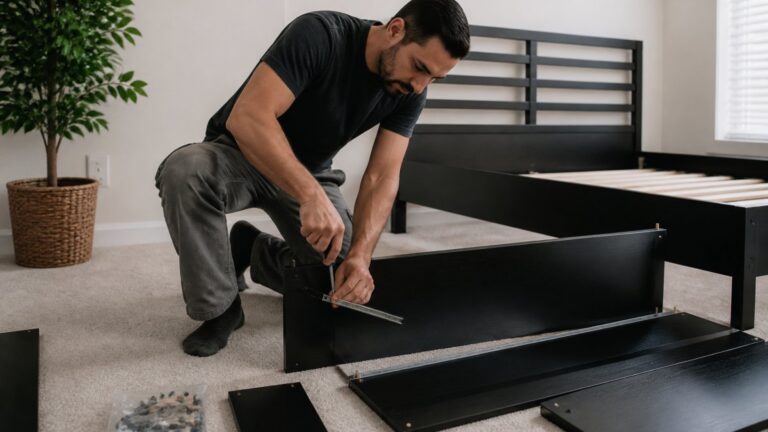
One customer put it simply: “Posted a furniture assembly job and had multiple bids in 30 minutes. The escrow system gave me total peace of mind.”
Ready to get started? Post your home project on Biddy Jobs and get Bids from ID-verified neighbors nearby. If you want the full walkthrough first, here is how to post a job for local help in seven simple steps.
Frequently Asked Questions
How can I safely hire someone for a home task?
Verify identity first: ask for government-issued ID and confirm the name matches the profile you found. Check customer reviews and ratings, and ask for references on similar jobs. Agree on a written scope and price before work starts, and pay through a platform with escrow rather than handing over cash upfront. On Biddy Jobs, users are ID-verified and payments are held in escrow until the job is done, which lowers the risk of paying for work that never happens.
What are red flags when hiring someone for a home project?
Watch for demands for full cash payment upfront, refusal to put scope or price in writing, no verifiable reviews or ID, pressure to decide immediately, and vague answers about insurance or damage handling. For movers, also treat unmarked trucks, no written estimate, and requests to sign blank paperwork as warnings. Any one of these is reason to pause; two or more means walk away and find help elsewhere.
Is it safer to pay a local worker through a platform?
Platforms with escrow add a layer of protection because your money is held until the work is confirmed complete, instead of going straight into a stranger’s pocket. Biddy Jobs uses in-app escrow powered by Stripe, so payment is held until the job is done. Cash or peer-to-peer transfers leave you with little recourse if the worker doesn’t show or the work is incomplete.
What should I check before hiring local help for a move?
Confirm the company or worker has a real address and phone number, check reviews across more than one source, and ask whether they carry insurance coverage for damage or liability. Get a written estimate that lists hourly rates and any fees, and never pay a large deposit before the truck arrives. Compare at least two or three quotes, and keep all communication in writing so you have a record if something goes wrong.
Hiring local help does not have to feel risky. Verify identity, ask direct questions, pay through escrow, and put the scope in writing. Biddy Jobs makes each of those steps easier with ID-verified users, in-app escrow payments through Stripe, and community ratings you can check before you book. Get started with Biddy Jobs and hire local help with confidence.